

Real-time applications such as AR/VR, telepresence and interactive AI services are placing new demands on home networks. For these services, low latency is essential to a smooth and reliable user experience. As traditional quality-of-service mechanisms reach their limits, L4S offers a new approach: it allows applications and networks to work together more closely to reduce latency and packet loss. This article examines how L4S can support future real-time services in the home network, with a particular focus on implementation in the home router and a practical demonstration of its impact.
Growing Demands on Latency and Transmission Quality
If you look up customer satisfaction rates for telecom providers online, the feedback is predominantly positive. For the most part, this satisfaction boils down to how users experience their everyday apps. Right now, most standard applications simply don’t demand a high level of network performance.
Web browsing, video streaming, social media, and cloud services generally work well enough—or are at least perceived as acceptable—even when minor, intermittent network disruptions affect technical transmission quality. The current exceptions to this rule are specialized user groups like online and cloud gamers. This demographic already expects consistently low latency, minimal jitter, and near-lossless data transmission.
However, a broader shift is on the horizon. Other applications will soon demand this same level of high performance. Examples include AR/VR applications, interactive AI services, and remote control systems. Driven by ongoing digitization, these technologies are highly likely to become commonplace in home networks.
Achieving and maintaining this strict quality metrics presents a clear technical challenge: current standard networking methods are no longer sufficient to guarantee this level of performance.
Cross-layer Approach
Today, both applications and networks independently attempt to utilize available resources as efficiently as possible, but they largely doing so without awareness from one another. At the application layer, technologies like adaptive codecs, dynamic bitrate control, and predictive buffering mechanisms are deployed to compensate for fluctuating network conditions. Meanwhile, at the network layer, mechanisms such as Active Queue Management (AQM) are used to detect congestion early, reduce packet loss, and maintain high link throughput.
While both approaches significantly improve QoE (Quality of Experience), they hit a hard limit when strict requirements for consistently low latency and ultra-low loss probabilities must be met. Applications typically react only after a degradation in transmission quality has already occurred. On the other hand, network mechanisms lack the granular sensitivity required to react dynamically to shifting load conditions.
To truly guarantee critical thresholds for latency and packet loss with high reliability, we need a coordinated, cross-layer approach. Only the synchronized interplay between both layers enables reactions that are fast enough to handle sudden load changes.
L4S as an Option
One approach designed to meet these stringent requirements is L4S: Low Latency, Low Loss, and Scalable Throughput. The primary goal of L4S is to maintain consistently minimal queues—and therefore ultra-low latency—even under high network load. The core concept shifts away from signaling congestion through packet loss; instead, it relies on early detection via Explicit Congestion Notification (ECN). To achieve this, specially designed Active Queue Management (AQM) mechanisms operate on very short queue thresholds, providing continuous and finely granulated congestion signaling.
The frequency of this signaling informs transport and application protocols exactly how much they need to adjust their data rates (hence, „scalability“). This allows them to react to emerging congestion much faster—within a single round-trip time (RTT)—and with far greater precision, preventing longer queues or packet drops from forming in the first place.
This mechanism is complemented by the Dual-Queue concept. Here, L4S-capable traffic is treated separately from legacy internet traffic. To ensure fairness, the scheduling of both queues is strictly coupled. This guarantees low latency for L4S packets without breaking backward compatibility with the existing internet. The foundational architecture and motivation behind L4S are defined in RFC 9330, while the requirements for scalable congestion control schemes are outlined in RFC 9331, and the Dual-Queue Coupled AQM approach is specified in RFC 9332.
Together, these mechanisms establish a framework where the application and the network cooperate much more closely than in the traditional best-effort internet, laying the groundwork for consistently low latency and minimal packet loss.
Will L4S Become Widely Adopted?
L4S is no longer confined solely to the research domain; it is already being deployed or prepared for deployment in initial real-world networks and platforms. In cable networks, leading players, including CableLabs, Vodafone, and other operators, are driving the integration of L4S into DOCSIS networks in order to guarantee minimal latency even under high load. In mobile networks, operators such as T-Mobile, together with partners such as NVIDIA, are using L4S mechanisms for latency-critical 5G applications.
In parallel, an important technical foundation has been established in the Linux kernel. In addition to modern queue management mechanisms, initial L4S-relevant components are already available there, in particular an implementation of the dual-queue concept based on DualPI2[1].
In the Wi-Fi environment, the Wireless Broadband Alliance (WBA) has also published initial “Implementation Guidelines for L4S in Wi-Fi Networks” to standardize the transfer of L4S concepts to modern Wi-Fi networks and ensure interoperability.
The Broadband Forum (BBF) has also begun incorporating L4S into future architecture and operational models for broadband access networks, currently still in the Working Draft WT-519.
Deployment and Migration
Deploying new mechanisms in existing Internet and access networks generally represents a significant challenge, as it involves substantial investment on the one hand and requires interoperability with the existing Internet ecosystem on the other. One of the key strengths of L4S is that it enables gradual deployment while maintaining a high degree of compatibility with the existing Internet.
A particularly relevant aspect is that actual bottleneck situations typically occur only at a limited number of clearly identifiable points — especially at network edges and interconnection points with constrained bandwidth, such as home routers, mobile cells, or access aggregation points. For L4S to be effective, it is therefore sufficient to place Dual-Queue AQM primarily at the expected congestion points in the edge domain.
This significantly reduces the deployment effort and opens up the possibility of an evolutionary migration toward latency-optimized networks.
Effectiveness in the Home Network
To investigate the impact of L4S on latency within a home network, we built a laboratory setup that replicates a typical residential scenario. Usually, a Customer Premises Equipment (CPE) device connects to the internet via xDSL, fiber, or cable. In our setup, the CPE is a Raspberry Pi 5 (RPi5)[1], configured as a router and Wi-Fi access point. Internet access is provided by a standard DSL router together with the Broadband Network Gateway (BNG) of the Internet Service Provider.
On the WAN interface of the CPE, we configured a virtual interface with DualPI2 for incoming traffic. Crucially, the available bandwidth is limited slightly below the actual line rate of the connection This bypasses the buffering mechanisms of the edge router and replaces them with the DualPI2 mechanisms at the virtual interface. For upstream traffic, a DualPI2 queue was also configured directly on the physical WAN interface.
We used Nvidia GeForce NOW cloud gaming as our L4S-capable application, logging the latency metrics reported by GeForce NOW second by second. By simulating various load conditions within the home network across multiple scenarios, we conducted A/B tests to compare performance with and without DualPI2 enabled.
Evaluation of Results
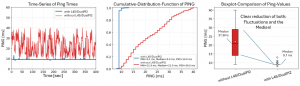
The impact of L4S and DualPI2 is particularly evident when analyzing the measured ping times. To visualize this, three distinct types of data representation are highly effective:
(1) Direct Time-Series Comparison: This visualization immediately highlights the contrasting behavior of the ping times. When DualPI2 is disabled, the latency constantly fluctuates between 10 ms and 40 ms throughout the measurements. With DualPI2 enabled, the ping remains virtually locked at 9 ms.
(2) Cumulative Distribution Function (CDF): Comparing the data in this aggregated form shows that with DualPI2 enabled, 99% of the ping times remain under 10 ms. Without DualPI2, this 99th percentile value is nearly four times higher.
(3) Boxplot Comparison: This side-by-side representation provides a very clear visual proof of how enabling DualPI2 drastically compresses what was previously a wide distribution of ping times.
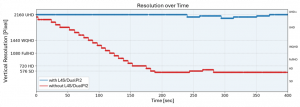
Beyond latency, there is another critical factor that directly impacts the gaming experience: video resolution. If transmission conditions degrade, the gaming servers will scale down the resolution if necessary. This reduces the required bandwidth in order to maintain playability.
As the figure below illustrates, with L4S and DualPI2 enabled, the resolution remains almost completely stable in the UHD+ range throughout the entire session. In contrast, without active L4S support, the resolution drops significantly into the SD (Standard Definition) range. On a high-resolution monitor, this artifact manifests as a blurry, washed-out image.
Conclusion
In summary, L4S offers significant potential: it enables the deployment of demanding, real-time applications within the home network with a level of implementation effort that remains highly manageable for service providers. However, a widespread rollout will heavily depend on economic viability and market adoption. The critical lever now lies primarily with the developers of these—often cloud-based—applications: how will they evaluate L4S, and how deeply will they integrate the technology into their software? Tracking the further adoption and evolution of L4S promises to remain highly interesting.
Want to know how L4S could shape your network strategy, or what impact this technology might have on your specific applications?
Get in touch with us! We would be glad to support and advise you on planning and implementing future-proof network architectures.
______________________________________
[1] DualPI2 is an Active Queue Management (AQM) mechanism designed for L4S that utilizes two coupled queues: an ultra-low-latency L4S queue and a classic queue for legacy traffic. By coupling both queues, DualPI2 ensures that L4S traffic achieves minimal delay without unfairly disadvantaging traditional TCP traffic.
[1] RPi5 running an updated Linux kernel (6.18y) and iproute2 version 7

Hinterlasse einen Kommentar